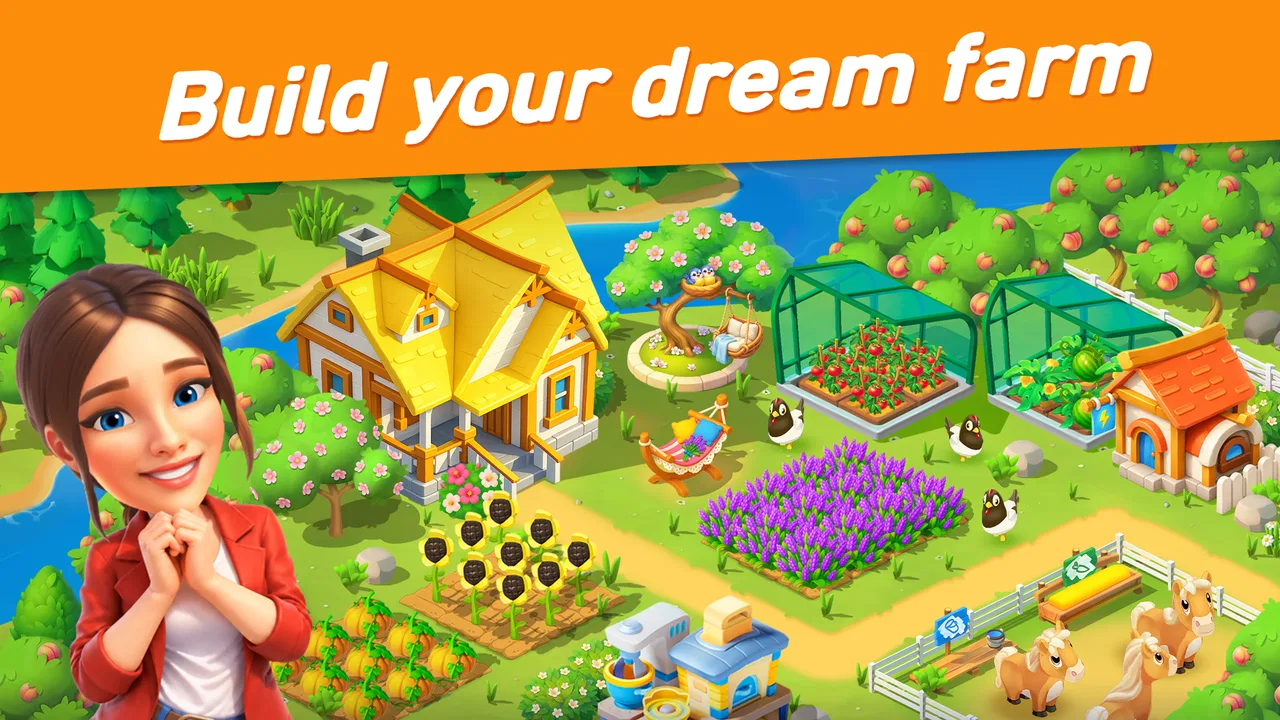
Goodville: Farm Game Adventure
- 4.5
- Rating
- 5.00M
- Installs
- Free
- Price

 Analysis by App-foxy
I approached Goodville: Farm Game Adventure expecting a familiar farming game, but its tone quickly felt different from the usual crop-and-upgrade routine. Developed by Goodville AG, it combines farm management with emotional well-being activities, so the game asks me to slow down as much as it asks me to expand a virtual homestead. That combination is its main appeal, but it also creates a few expectations that are worth understanding before you install it.
At its best, Goodville gives me a gentle reason to check in, complete small tasks, and take a break from more demanding games. It is free to download and suitable for Everyone, although optional purchases range from $1.99 to $139.99 per item. The game has built a substantial audience, with over 5 million installs, an average rating of 4.5 from around 146 thousand ratings, and roughly 8.3 thousand written reviews. Those figures suggest that its relaxed approach connects with many players, but they do not remove the need to decide whether its pace suits you.
Getting comfortable with the farm and its slower rhythm
I found it helpful to approach Goodville as a place to settle into rather than a farm to optimize at once. In this section, I’ll look at how its relaxed pace changes the usual farming-game routine and why following the early prompts can make the experience clearer. That slower start also sets up a practical question: how to keep a session comfortable when a phone, connection, or interruption gets in the way.
You May Also Like

 Blood Strike: 2.5 Anniversary
Blood Strike’s Loadouts Turn Every Drop Into a Tactical Gamble
A close look at Blood Strike’s custom loadouts: how fast access to signature weapons reshapes its battle royale rhythm, rewards preparation, and narrows the gap between fights.

 Pandora - Music & Podcasts
Pandora’s Music Is Easy to Start, but Harder to Recover
Pandora’s strength is its low-effort path from a seed to a station. Its weak spot is how much confidence it asks you to place in connection, setup, and quiet recovery.

 8 Ball Pool
 Is Built on Rivalries, Rematches, and Routine
A close look at the rivalries, rematches, shared routines, and unanswered safety questions that turn a quick pool match into a persistent mobile community.

 Samsung Music
’s Quiet Strength Is Playing What You Already Own
Its reach comes less from spectacle than from dependable access to a personal library. That simplicity is both the app’s strongest retention engine and its ceiling.

 AccuWeather: Weather Radar
AccuWeather Review: A Quick, Clear Forecast for Everyday Decisions
For everyday plans, the best forecast is the one you can understand quickly. AccuWeather makes rain timing, radar, and local conditions easy to act on, with a few trade-offs.

 Hill Climb Racing
Why Hill Climb Racing Still Turns Crashes Into One More Run
A tiny car, a bumpy hill and one more upgrade: Hill Climb Racing keeps resurfacing because its simple chaos makes every near-miss feel personal.
More From Our News Desk
View All News


Why the first steps can feel less obvious
The opening experience is not simply a race to produce as much as possible. I found that Goodville works better when I treated early tasks as a guided routine rather than trying to optimize every action. The farm setting gives the game a recognizable structure, yet the emotional well-being angle means the experience is not built around constant pressure or aggressive competition.
That can be a pleasant surprise if you normally play farming games to unwind. It can also be confusing if you expect the immediate clarity of a traditional management game. In a more conventional alternative, I usually know that planting, harvesting, selling, and expanding are the central loop. Here, the surrounding well-being content changes the mood and the purpose of those activities. The farm is not only a production puzzle; it is also the setting for a calmer daily interaction.
My practical advice is to read the early prompts instead of tapping through them automatically. When a game mixes two genres, the instructions are doing more work than usual. Skipping them can leave you wondering why a task matters or how it fits into the larger flow. If the first session feels slower than expected, that is not necessarily a technical problem. It is often a sign that Goodville wants you to follow its pace.
Setup checks that prevent avoidable frustration
Before blaming the game for a stalled session, I would begin with simple checks. I make sure the installation has finished properly, open the game with a stable connection when possible, and close other demanding apps if the phone is struggling. These are ordinary steps, but they matter more in a game that may need to load several kinds of content while moving between farm activities and its well-being material.
I also recommend starting with enough battery and avoiding the first session when the device is already hot. A warm phone can make any game feel sluggish, and that can be mistaken for a problem inside Goodville. If the game behaves normally after a fresh restart, the issue was probably the device state rather than the farm itself.
Another useful check is storage space. A phone that is nearly full can behave unpredictably during installation or updates. I would leave room for the game and its normal operating needs, then restart the device before trying again. If the app opens but a particular part does not load, I would first return to the main screen, wait briefly, and try the action again instead of repeatedly tapping it.
Goodville is free to begin, which makes it easy to test without committing money immediately. Still, I would not treat optional purchases as a setup requirement. The listed in-app purchase range reaches from $1.99 to $139.99 per item, so I would review device purchase protections before handing the phone to a child or letting someone else play. The Everyone rating describes the intended age suitability, but it does not mean every player will enjoy the same pace or spending choices.
Recovering when progress feels stuck
One of the most useful habits I developed was separating a genuinely blocked task from a task that simply needs another action first. In a farming game, a goal can appear inactive because a prerequisite has not been completed, a resource has not been collected, or the next instruction has not been acknowledged. I check the current objective carefully, revisit nearby activity points, and look for an unfinished step before assuming the game has failed.
If the screen stops responding, I close Goodville completely and reopen it rather than repeatedly pressing the same control. A clean restart is a safer first response than deleting the app, especially when I care about local progress. I would only consider reinstalling after checking how progress is preserved on the device and whether I can reliably return to the same game state. Removing an app too quickly can turn a temporary loading issue into a real loss of progress.
When an action seems to do nothing, I also check whether the game is waiting for a tap in another part of the screen. Smaller displays, accessibility settings, or a protective case can make edge controls awkward. Rotating the phone is not something I would assume will help, but holding it steadily and tapping the visible prompt once is better than rapid repeated taps.
A second practical insight is to avoid spending resources immediately after recovering from a freeze or interrupted session. I first confirm that the game has returned to the expected state. If I rush into a purchase, upgrade, or collection action while the connection is unstable, I may create confusion about what was actually registered. Waiting for the farm to settle is a small habit, but it makes troubleshooting much easier.
Handling interruptions without turning the game into a chore
Goodville makes more sense as a short, repeatable check-in than as a game I must play for a long uninterrupted stretch. In an everyday scenario, I might open it after work, complete a few farm tasks, spend a moment with the well-being content, and close it before the session starts feeling like another obligation. That approach matches its calm identity better than trying to clear everything in one sitting.
If I am interrupted by a call or another app, I return slowly and check what is currently displayed. I do not assume that the last tap completed if the game was backgrounded at the same moment. I look for the visible result, then continue from the active objective. This is especially useful when playing on a phone with aggressive battery management, because backgrounded games can resume less smoothly than expected.
For a family device, I would create a clear routine around purchases and play time. The game is accessible enough for younger users under the Everyone rating, but the presence of optional items means the device owner should control spending. I would also explain that progress is not the same thing as speed: finishing every available task immediately is not necessary to get value from the experience.
When the problem is probably outside Goodville
Not every failed load or delayed response comes from the app. A weak connection, crowded home network, low storage, an overheated phone, or an operating system that needs attention can all produce similar symptoms. I test another app or webpage on the same device, switch between available connections when appropriate, and restart the phone before drawing conclusions.
If only Goodville is affected while everything else works, I check whether the app needs an update through the normal store process. If several apps are slow, the wider device environment deserves attention first. This distinction saves time and prevents the common mistake of reinstalling a game when the real issue is the phone or network.
I would also avoid using unofficial download packages or modified versions to solve a loading or purchase problem. They can introduce new risks and make it impossible to know whether the original game is responsible. The safest troubleshooting path is the ordinary installation, a restart, a connection check, and a careful look at the current task.
What makes its well-being focus useful
The emotional well-being element is not just decoration in my experience. It changes how I judge success. In many farming games, I feel pushed toward maximizing output, unlocking land, and repeating the most profitable actions. Goodville encourages a less competitive mindset, which can make it a better fit for someone who wants a soft landing after a stressful day.
That does not make it a replacement for professional mental-health support, and I would not use it that way. Its value is closer to a guided pause wrapped in an adventure-farming setting. If I want a serious productivity system, a dedicated well-being app, or structured clinical support, I would choose a purpose-built option instead. Goodville is most convincing when I want light interaction and a calmer atmosphere in the same place.
A non-obvious trade-off is that the two sides of the game may appeal to different moods. On a day when I want deep planning, the well-being pacing can feel like an interruption. On a day when I want to relax, the farm tasks can provide just enough structure to keep the session engaging. I would judge it by the kind of break I need, not only by whether I usually enjoy farming games.
How it compares with familiar farming alternatives
Compared with a traditional farm builder, Goodville feels less focused on pure optimization. I would choose a standard alternative if my priority were detailed production chains, rapid expansion, or a highly competitive progression loop. Those games usually make efficiency the central satisfaction. Goodville instead gives more weight to atmosphere and emotional pacing.
Compared with a dedicated relaxation or mindfulness app, it is more playful and interactive. The farm gives me a reason to return, while the well-being material adds a reflective layer that a simple decorating game may not provide. The trade-off is that it may not offer the depth of a specialist app designed around one specific wellness method.
Compared with a story-driven adventure game, Goodville is gentler and less demanding. I would not install it for intense action, complex combat, or a dramatic challenge. Its adventure label is best understood through exploration and progression within its farm-centered world, not through the expectations I would bring to a fast-paced console-style adventure.
Who should try it, and who should skip it
I think Goodville is a strong candidate for players who like casual farm games but want something more reflective than a simple harvest loop. It also suits people who prefer short sessions, a friendly atmosphere, and a game that does not constantly demand maximum performance. Families may appreciate the Everyone rating, provided an adult manages purchase settings and explains the difference between free play and optional spending.
I would skip it if I dislike slow progression, dislike well-being prompts inside entertainment, or want a game where every minute produces a clear strategic advantage. I would also look elsewhere if I am searching for a serious mental-health tool, a competitive farming simulator, or a visually intense adventure. Goodville occupies a middle ground, and that middle ground is either its strength or its limitation depending on what I want.
My practical verdict after settling into the routine
After giving the game time to establish its rhythm, I found its best quality was consistency of mood. It offers a small farm to manage, but it does not treat the player like an employee racing against a clock. The emotional well-being focus gives ordinary tasks a different context, and that makes the experience more personal than its simple store summary might suggest.
The main friction comes from expectations. Players who enter expecting a conventional farming simulator may wonder why the game pauses for reflective material or why progress feels intentionally measured. Players who expect a dedicated wellness product may find the farm layer too game-like. Understanding that compromise before installing it prevents most disappointment.
My recommendation is to try it as a gentle daily game rather than a title to conquer. Keep the first session unhurried, check the device and connection if something behaves oddly, and avoid spending until you know whether the rhythm suits you. Goodville works best when the farm supports your downtime instead of becoming another task list. For me, that makes it a worthwhile free adventure for relaxed players, while more demanding farmers and users seeking specialized wellness support will be happier with a more focused alternative.
FAQs for Goodville: Farm Game Adventure
01What is Goodville: Farm Game Adventure about?
Goodville: Farm Game Adventure is a unique blend of farming simulation and adventure game elements. Players can cultivate crops, raise animals, and explore a rich storyline filled with quests and challenges. The game offers a relaxing yet engaging gameplay experience, perfect for fans of farming and adventure genres.
02Is Goodville: Farm Game Adventure free to play?
Yes, Goodville: Farm Game Adventure is free to download and play. However, it offers in-app purchases that can enhance your gameplay experience. These purchases can include special items, currency packs, or boosters. Players can enjoy the game fully without spending money, but purchases can speed up progress.
03What platforms is Goodville: Farm Game Adventure available on?
Goodville: Farm Game Adventure is available on both Android and iOS platforms. You can download it from the Google Play Store for Android devices and the Apple App Store for iOS devices. Ensure your device meets the necessary requirements for optimal performance and gameplay experience.
04Does Goodville: Farm Game Adventure require an internet connection?
Yes, Goodville: Farm Game Adventure requires an internet connection to download updates, participate in events, and interact with online features. While some aspects of the game may be playable offline, an active internet connection ensures you can fully access all features and stay updated with the latest content.
05Are there any age restrictions for playing Goodville: Farm Game Adventure?
Goodville: Farm Game Adventure is generally suitable for players of all ages, but it is recommended for ages 12 and up due to in-app purchase elements and online interactions. Parents should monitor younger players to ensure a safe and enjoyable gaming experience, especially regarding in-game purchases.
Pros
- Engaging storyline with diverse characters.
- Beautiful graphics create an immersive experience.
- Regular updates with new challenges and events.
- User-friendly interface for seamless navigation.
- Offline mode available for uninterrupted play.
Cons
- In-app purchases can get expensive quickly.
- Some tasks require long waiting times.
- Limited storage can hinder game progress.
- Occasional ads disrupt gameplay experience.
- Requires a stable internet connection for updates.

Goodville: Farm Game Adventure
Gallery